The Local Advantage: What Community-Rooted Trades Companies Have That Capital Can't Buy
As capital moves into HVAC and home services faster than ever, here is the case for the local, independent, community-engrained operators still built to win.
- HVAC saw 149 M&A transactions in 2025 (Capstone Partners), and PE add-on deals specifically rose 88% year-over-year through mid-2025 (S&P Global Market Intelligence). Financial buyers now account for roughly half of new HVAC deals, up from about a third a year earlier. That's half of transactions, not half of companies; independent ownership still makes up the large majority of the industry.
- Capital is very good at systemization, marketing scale, and back-office efficiency. It's built to optimize a platform, not to deepen one company's roots in one community.
- Three assets can't be bought or replicated by capital: name-level customer trust, mission-driven technicians, and community standing built over the years. These compound quietly, and there's no acquisition line item for them.
- Being local and independent isn't a fallback position; it's a genuine structural advantage right now, if an operator invests in it deliberately.
- Selling your business isn't the automatically right answer for every owner. The opportunity is deciding on purpose, not drifting.
What's happening to HVAC and Home Services right now?
Private equity is buying up fragmented, essential-service trades businesses faster than at any point in the industry's history, because it can add hundreds of companies into a single "platform" and sell that platform at a far higher valuation than any single business command on its own.
The numbers from 2025 tell the story. Capstone Partners tracked 149 HVAC-services M&A transactions for the year. S&P Global Market Intelligence found PE add-on deal volume targeting HVAC service providers up 88% year-over-year through mid-2025 — a sharper acceleration than the overall deal count alone shows. And per Capstone, financial buyers now account for roughly half of new HVAC transactions, up from about a third the year before. Worth being precise here: that's half of this year's deals, not half of the industry — independent, non-PE-owned operators still make up the large majority of HVAC companies nationally. The acceleration in new activity is the real story, not a claim that independents are already a minority.
Three things make HVAC (and plumbing, electrical, and adjacent home services) attractive to this kind of capital specifically:
- Fragmentation.
Tens of thousands of independently owned shops, none of them large enough to be a "platform" on their own — ideal raw material for a roll-up.
-
Recurring, essential revenue.
HVAC systems fail regardless of the economy. Membership and maintenance contracts create subscription-like revenue investors already know how to value. -
An aging owner base with no succession plan.
A large share of trades owners are nearing retirement with no obvious next-generation buyer, and a PE-backed platform offering a clean, fast exit is an easy yes when there's no other offer on the table.
|| Whether you view this as good or bad for our industry is ultimately up to you. It's just the context every independent operator is now competing inside, whether they've priced it in or not.
How the Roll-Up Playbook works
PE buys small trades companies at a lower valuation multiple, combines them into one larger "platform" company, strips out duplicate costs, and sells the combined platform at a materially higher multiple — the profit comes from the size of the company, not from running any single shop better.
This is often called multiple arbitrage, and it's worth understanding because it explains almost every downstream change an acquired company goes through:
- Acquire small. Individual shops typically sell in a lower valuation range because buyers see them as owner-dependent and risky without the founder.
- Combine into a platform. Ten, fifty, two hundred shops under one back office. Shared finance, shared marketing, shared call center — this is where the "synergy" actually comes from: overhead that used to run ten times now runs once.
- Standardize. Pricing books, service menus, technician scripts, and software get unified across every acquired location, regardless of what worked locally before.
- Sell the platform. Investors buy platforms, not shops, and they'll pay a much higher multiple for one company doing $200M in revenue than for the same revenue split across forty independent owners — even though the actual work being done hasn't changed.
|| The math only works at scale. A single technician's relationship with a single family isn't a line item a platform model is built to price, which is exactly why that kind of relationship has to be built and protected at the local level. It's not a gap in the roll-up strategy. It's a different game entirely, and it's the one independents are already positioned to win.
What consolidation optimizes for
A platform model is built to optimize systemization, marketing scale, and back-office efficiency across many locations at once, which is a genuinely different operating goal than deepening one company's roots in one community.
Neither goal is wrong. They're just different, and it's worth naming the difference plainly instead of guessing at it:
- Centralization. Call handling, dispatch, and back-office functions typically consolidate into a shared regional or national system, built for consistency across dozens of markets at once.
- Standardization. Pricing books, service menus, and technician training get unified across every location, built for the average market, not any single one specifically.
- Distributed governance. Decisions move from a single accountable local owner to a management structure spanning multiple locations, with real advantages in scale and real distance from any one neighborhood.
- Layered branding. A local name can continue to operate under a platform's ownership and reporting structure, carrying decades of local reputation into a new operating system.
|| This is simply what capital is good at, and it's worth taking seriously. The opening this creates for independents isn't a weakness in that model. It's a different arena entirely, one built on relationship depth a platform isn't structured to optimize for at all.
The Independent Advantage: What Capital Can't Buy
Capital can buy trucks, software, and market share, but it cannot manufacture the three things that make an independent operator durable: a name-level trust with customers, technicians who stay because they believe in the mission, and standing in the community that was earned, not marketed.
Break down why each one resists acquisition, and what actually builds it:
-
Name-level trust.
A customer who calls you by name, not "the HVAC company," has a relationship a platform brand can't replicate no matter how good its Google reviews are. This is built one honest interaction at a time — the callback you made when you didn't have to, the diagnosis you didn't upsell. There's no acquisition line item for "years of not overcharging people." -
Mission-driven technicians.
A tech who stays because they believe in why the company operates the way it does is fundamentally harder to poach than one who stays for pay alone — and pay is the only lever a consolidator reliably controls. This is why leadership behavior (not compensation) is usually the real retention strategy in a tight labor market. -
Community standing.
Sponsorship of the local little league team, showing up at the chamber event, being the shop three generations of a family have used — this reputation compounds over years and evaporates the moment ownership becomes a spreadsheet in another state. It's also the one advantage a newly acquired platform company structurally cannot buy back quickly, because community trust doesn't transfer with a bill of sale.
|| None of these show up on a balance sheet. All three show up in whether a customer calls you or Googles "HVAC near me" the next time something breaks, which is exactly why they're the actual competitive moat in a consolidating market.
If this resonated, we built this for you.
This five-minute self-assessment measures the drivers of long-term independence:
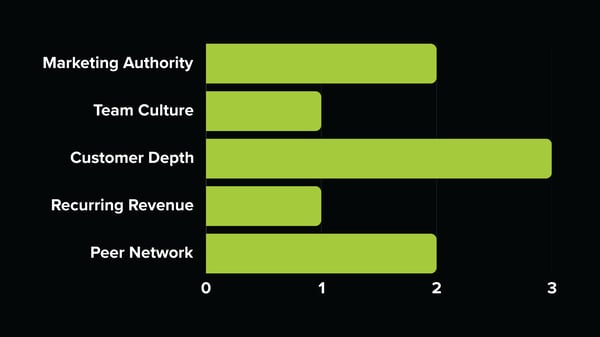
It will help you identify where your competitive advantage is already compounding and where you should invest next.
What "Community-Engrained" looks like
An engrained local operator is one whose roots show up in specific, visible ways a newly assembled platform can't fake or shortcut, no matter how much capital is behind it.
It's concrete, not a slogan:
- Multi-generational customers. A grandmother, her daughter, and her granddaughter all call the same company because the family always has, not because of a coupon.
- The owner known by name. Not "the CEO of a portfolio company," but a person a customer might run into at the grocery store, and would say hello to.
- The same crew, over years. A homeowner recognizes the technician who shows up, and the technician recognizes the house.
- Local reinvestment. Payroll, sponsorships, and vendor relationships stay inside the community instead of rolling up to investors somewhere else.
- Showing up when there's nothing to sell. Sponsoring the little league team, sitting on the chamber board, showing up at the ribbon-cutting for a business that isn't yours — because the community is the point, not a channel.
|| None of this is nostalgic. It's a genuine operating advantage in a market where a growing share of competitors are optimized for scale instead of for the next thirty years in the same zip code.
Should you ever consider selling?
I'm not here to say selling to a PE-backed platform isn't automatically the wrong move, but it should be a deliberate decision made from a position of strength, not a default outcome of having no succession plan or losing ground to bigger competitors.
There are legitimate reasons an owner sells: no family successor, a health event, wanting liquidity after decades of risk, or genuinely believing a bigger platform can serve customers better than a solo operation can at scale. Those are real, adult reasons to take a deal.
The problem is the default path: an owner who never actively decided to stay independent, never invested in the three compounding advantages above, and one day gets an offer that looks good, mostly because nothing else was built to compare it against. That owner isn't really choosing to sell. They're accepting the only option they gave themselves.
|| The fix isn't an anti-PE stance. It's building trust, team, and community deliberately enough that selling (if it ever happens) is a choice made on your terms, instead of the only door left open.
Is private equity buying HVAC and home service companies right now?
Yes, and the pace is accelerating. HVAC saw 149 M&A transactions in 2025 (Capstone Partners), PE add-on deal volume specifically rose 88% year-over-year through mid-2025 (S&P Global Market Intelligence), and financial buyers now represent roughly half of new HVAC transactions, up from about a third the year before (Capstone Partners). That's half of new deals, not half of the industry — most HVAC companies remain independently owned.
What does a platform/consolidation model optimize for?
Systemization, marketing scale, and back-office efficiency across many locations at once — typically through centralized call handling and dispatch, standardized pricing and training, and a management layer spanning multiple markets. It's a genuinely different operating goal than deepening one company's roots in one community, not a worse one.
Can an independent HVAC or home services company compete with a larger, capital-backed platform?
Yes, on the dimensions capital isn't structured to build: direct customer trust, technician loyalty built on culture rather than pay alone, and community standing earned over years. Platforms generally win on scale and marketing budget; independents generally win on relationship depth and local reputation.
What is the Independent Advantage Scorecard?
It's a free, five-minute self-assessment from WholeHome Alliance covering 15 points across five business dimensions, built to show an operator exactly where their independent advantage is compounding and where it's exposed. Score yours here.
Should I sell my trades business to a private equity-backed platform?
There's no universal answer — it depends on succession plans, personal goals, and how much of your value is genuinely independent versus owner-dependent. The goal is to make that decision deliberately, from strength, rather than by default because no alternative was ever built.
If you'd like support discussing your options, you can connect with our community or the WholeHome Alliance team directly to find the best path for you.